
The Historical Lexicon
Thirteen volumes and more than ten thousand densely set pages on the villages, the people and the history of the province of Kalavryta.
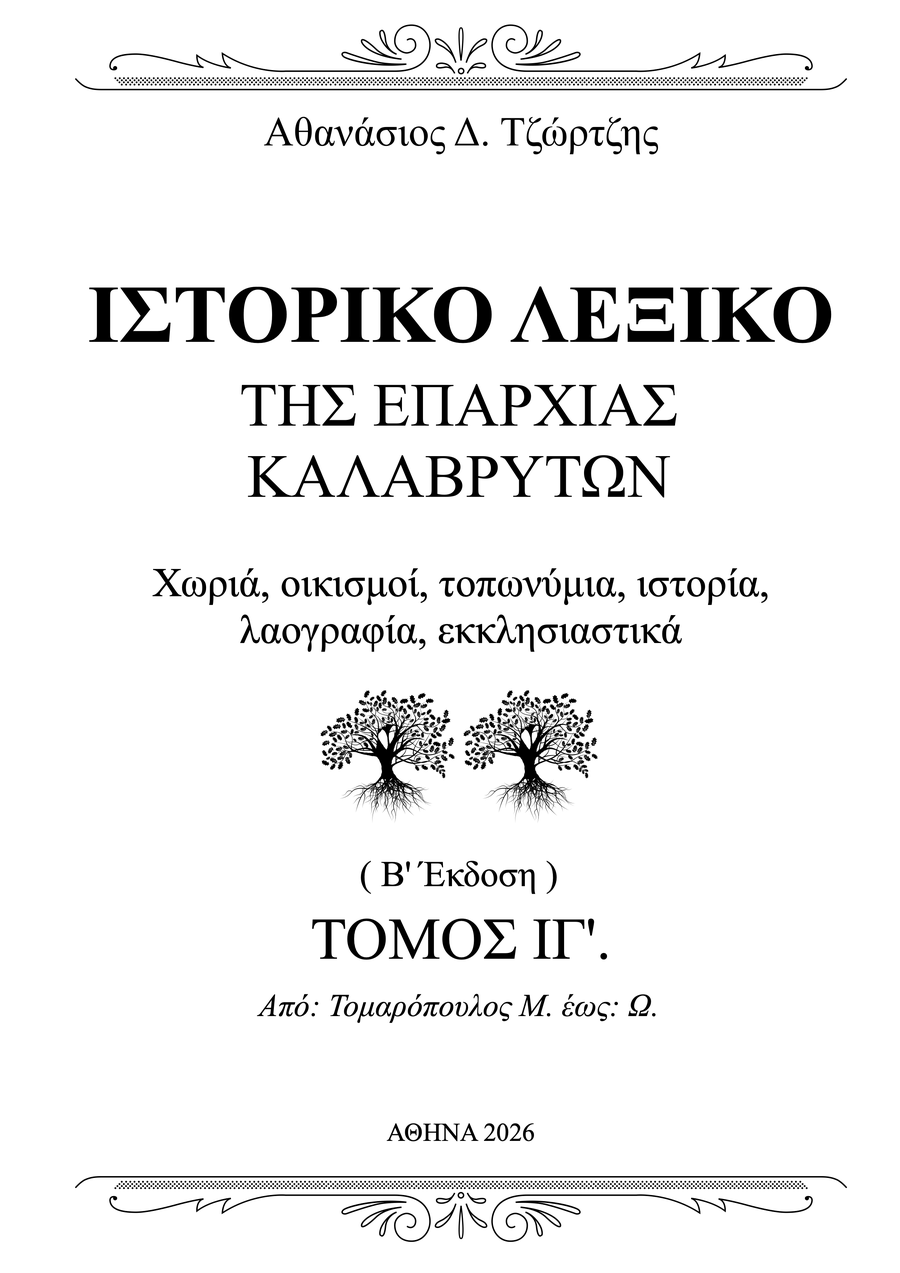
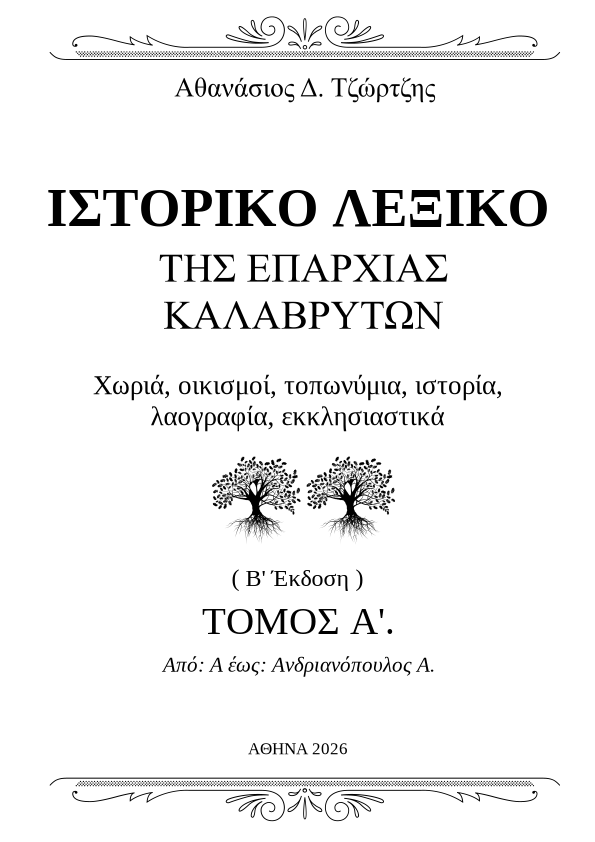


The 13-volume edition
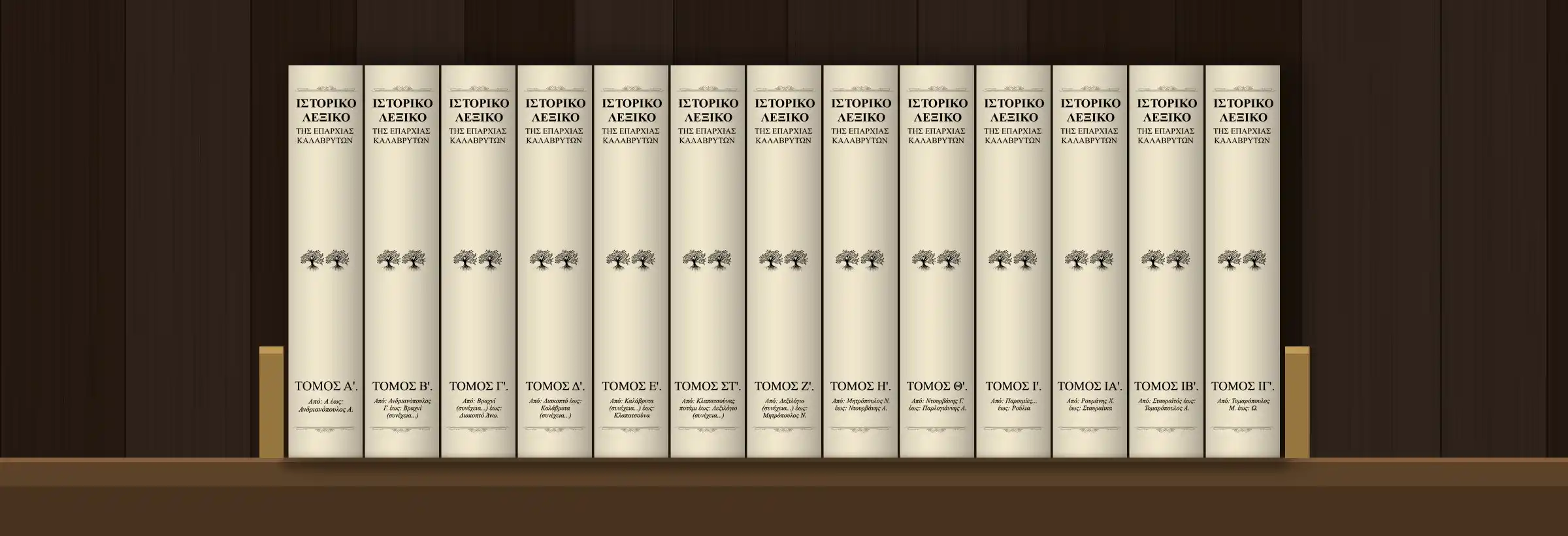
The “Historical Lexicon of the Province of Kalavryta” has been reprinted in 13 volumes of 800 densely set pages each, expanded and revised. It incorporates the 7-volume first edition — including its prefaces — together with everything that has come to light since.
It is the product of twenty years of historical research in primary sources, each one clearly cited in every entry. The opening pages of Volume I list every source in full, along with the abbreviations used.
Mainly because of the high cost of printing, only a handful of sets were produced, and it is not sold in bookshops.
- volumes
- 13
- pages per volume
- 800+
- cm · 4 cm thick
- 17×24
- cream paper
- 85 gsm
- edition · Athens 2026
- 2nd
- alphabetical entries, in Greek
- Α–Ω
The thirteen volumes
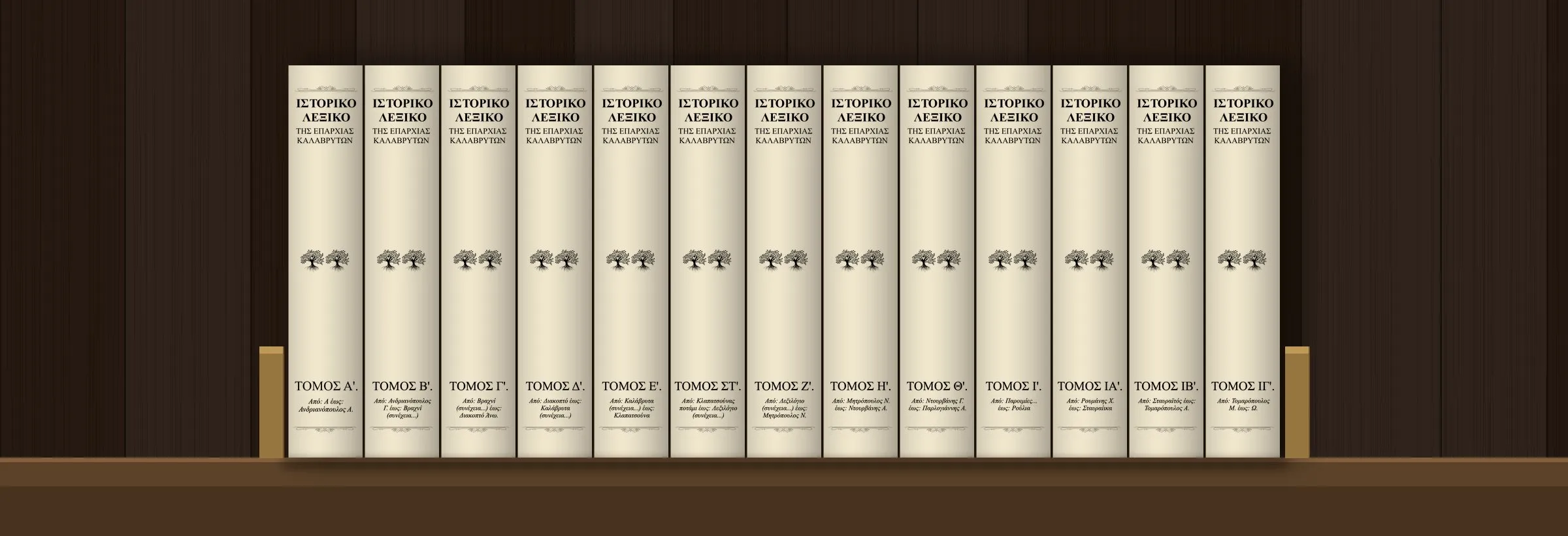
Choose a spine to jump to that volume. Entry names are shown in Greek, as in the books.











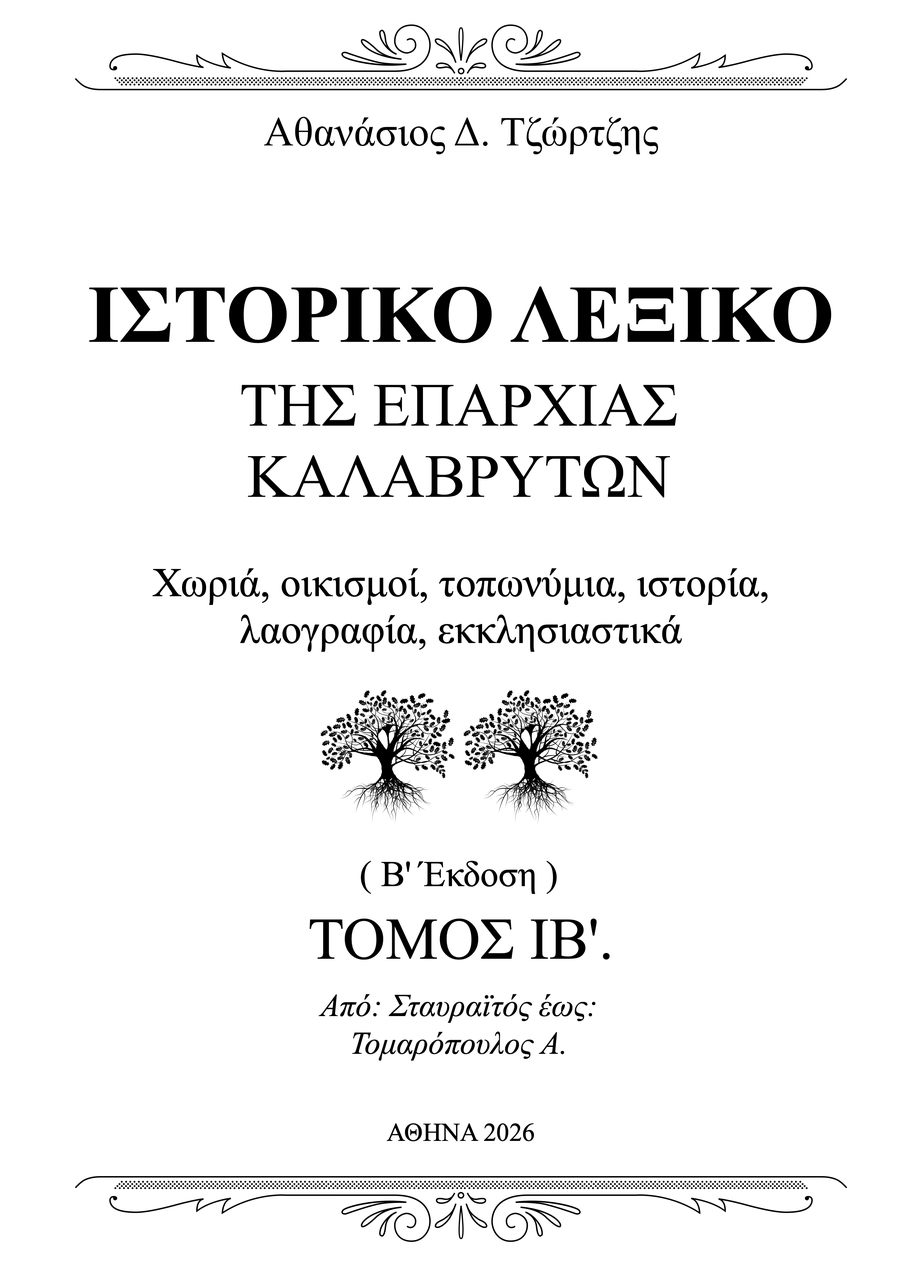

-
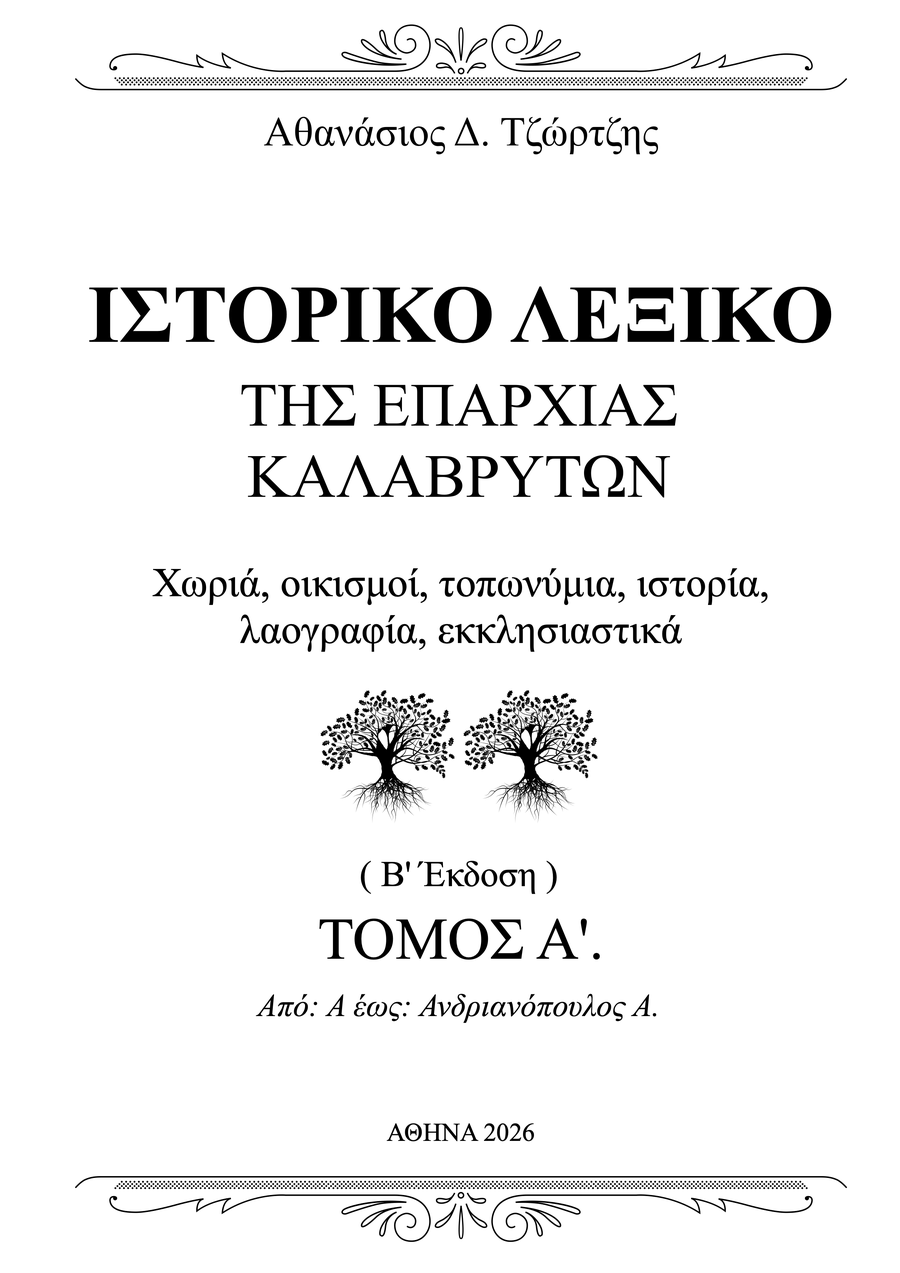
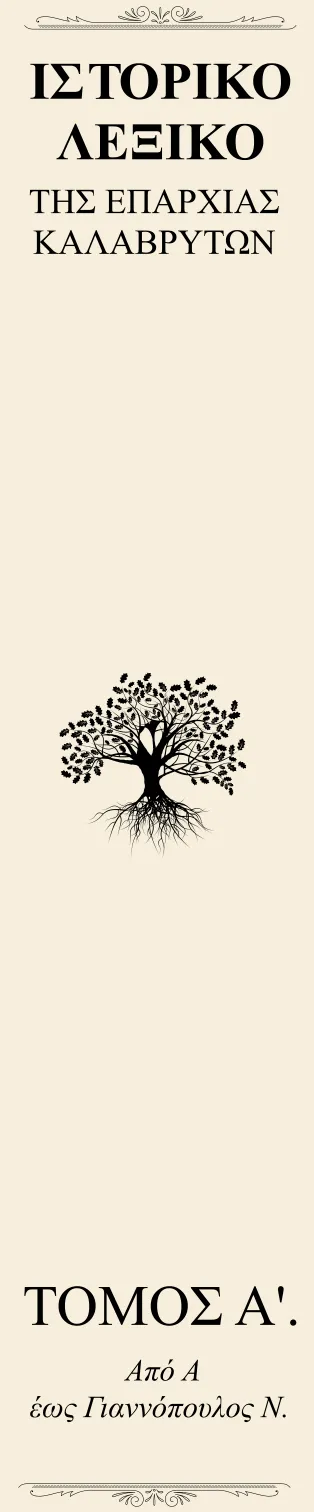
Volume Α΄ from Α
to Ανδριανόπουλος Α. -
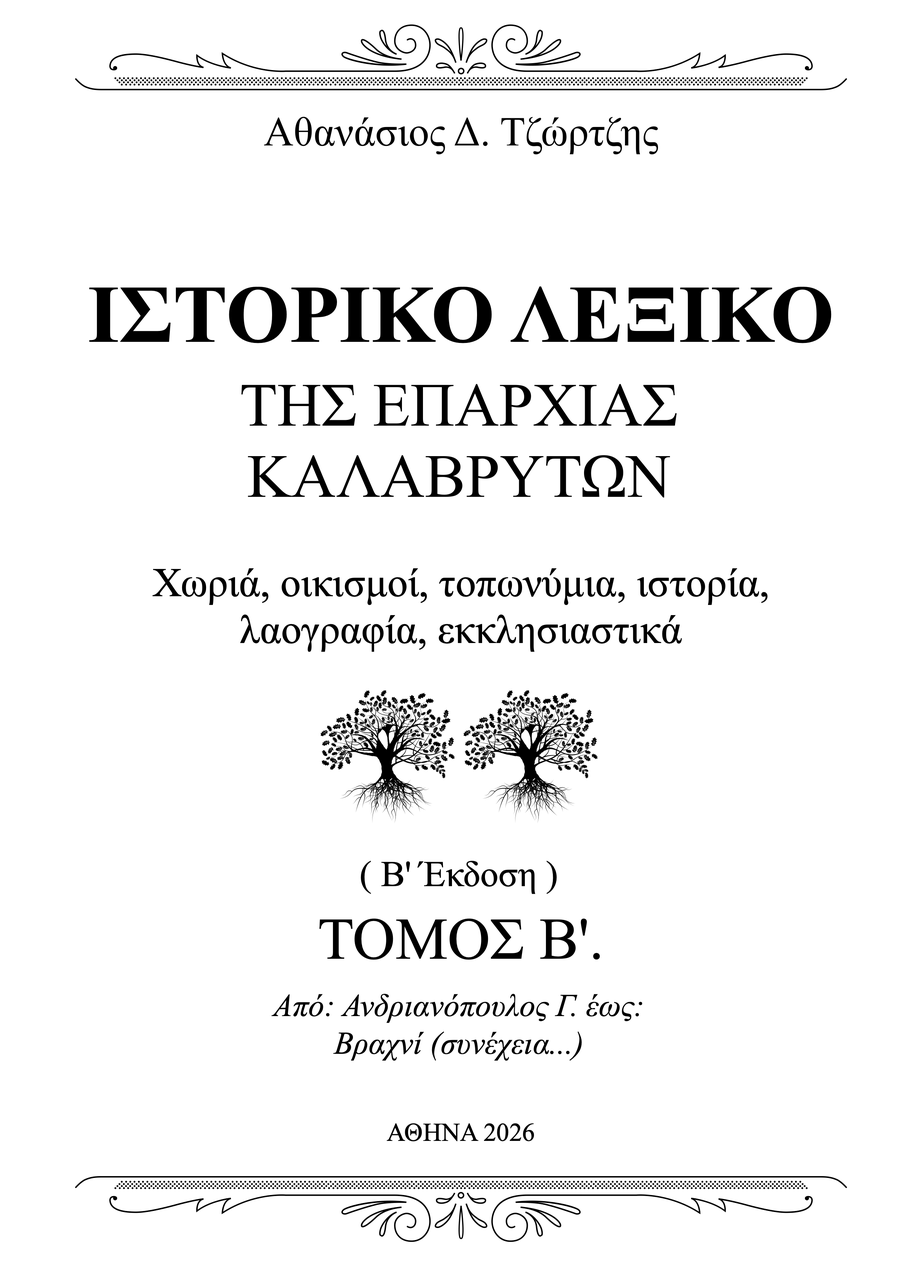
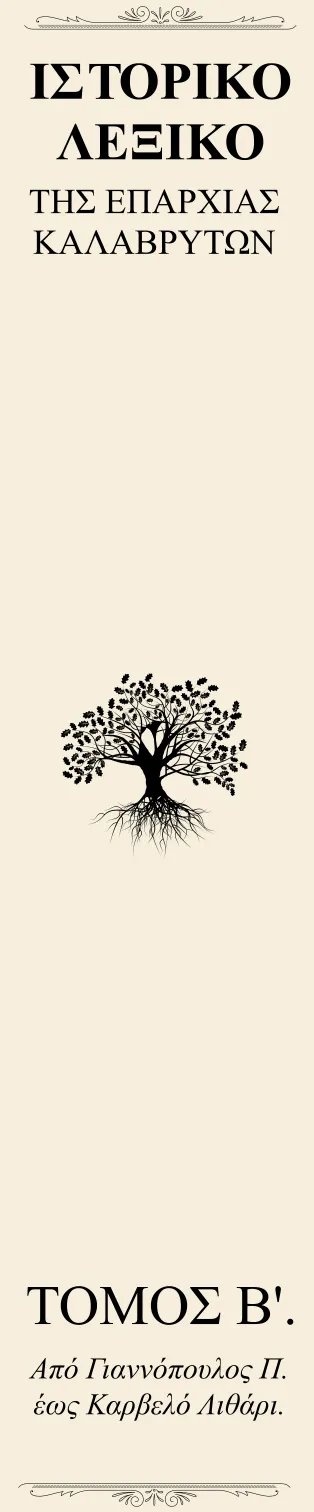
Volume Β΄ from Ανδριανόπουλος Γ.
to Βραχνί (συνέχεια…) -
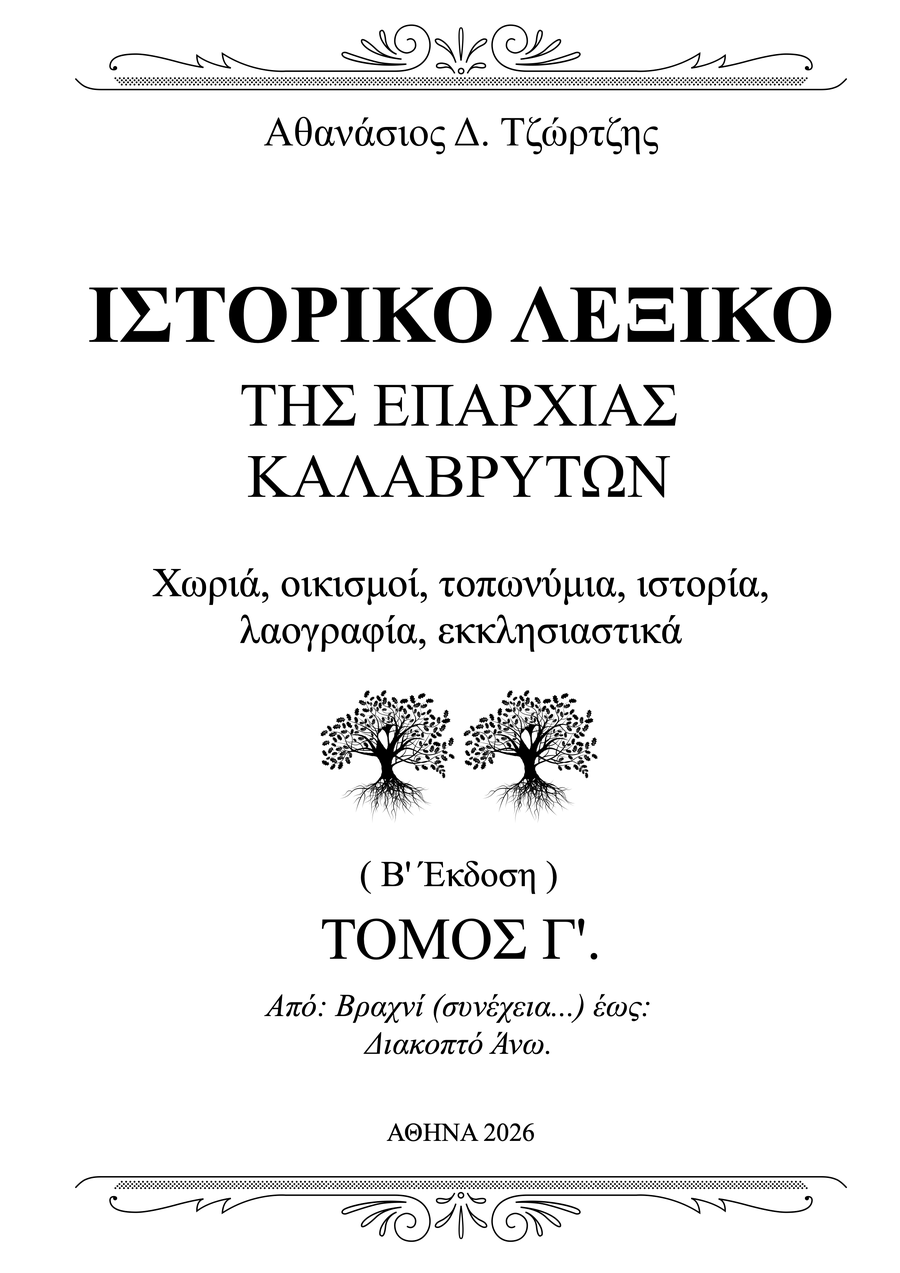
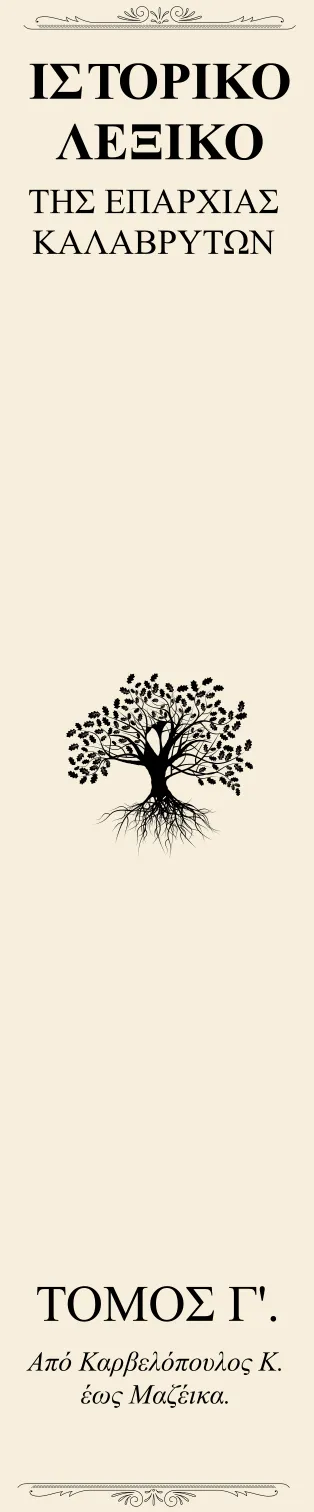
Volume Γ΄ from Βραχνί (συνέχεια…)
to Διακοπτό Άνω -
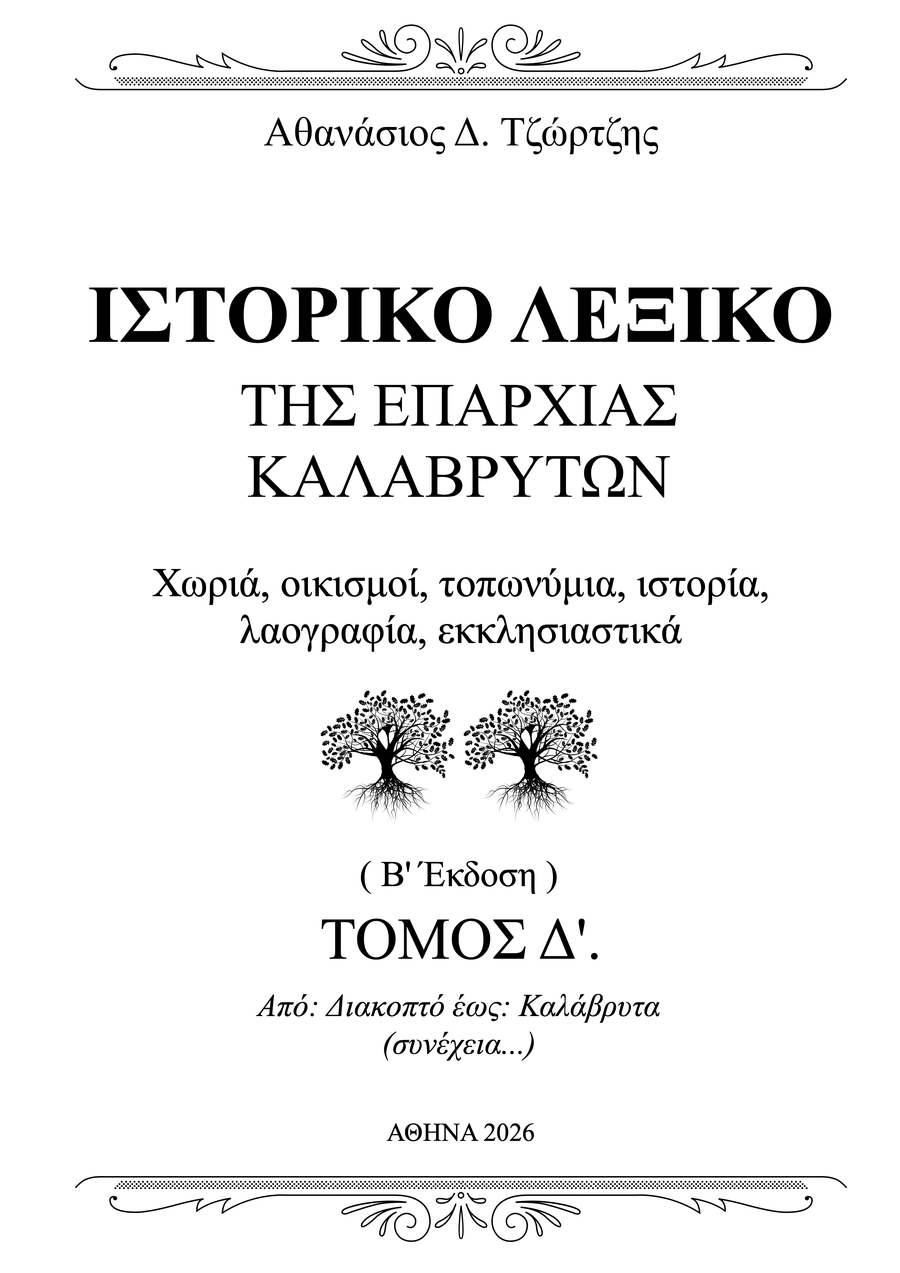
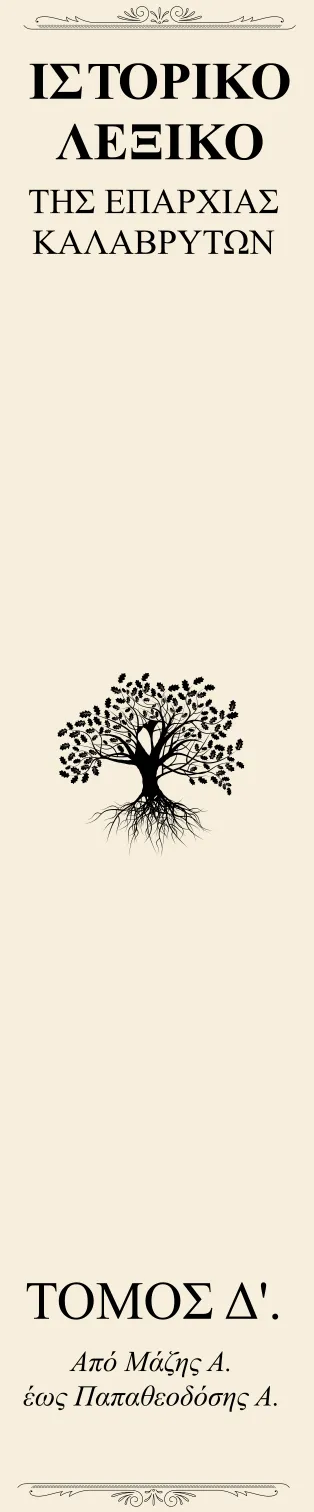
Volume Δ΄ from Διακοπτό
to Καλάβρυτα (συνέχεια…) -
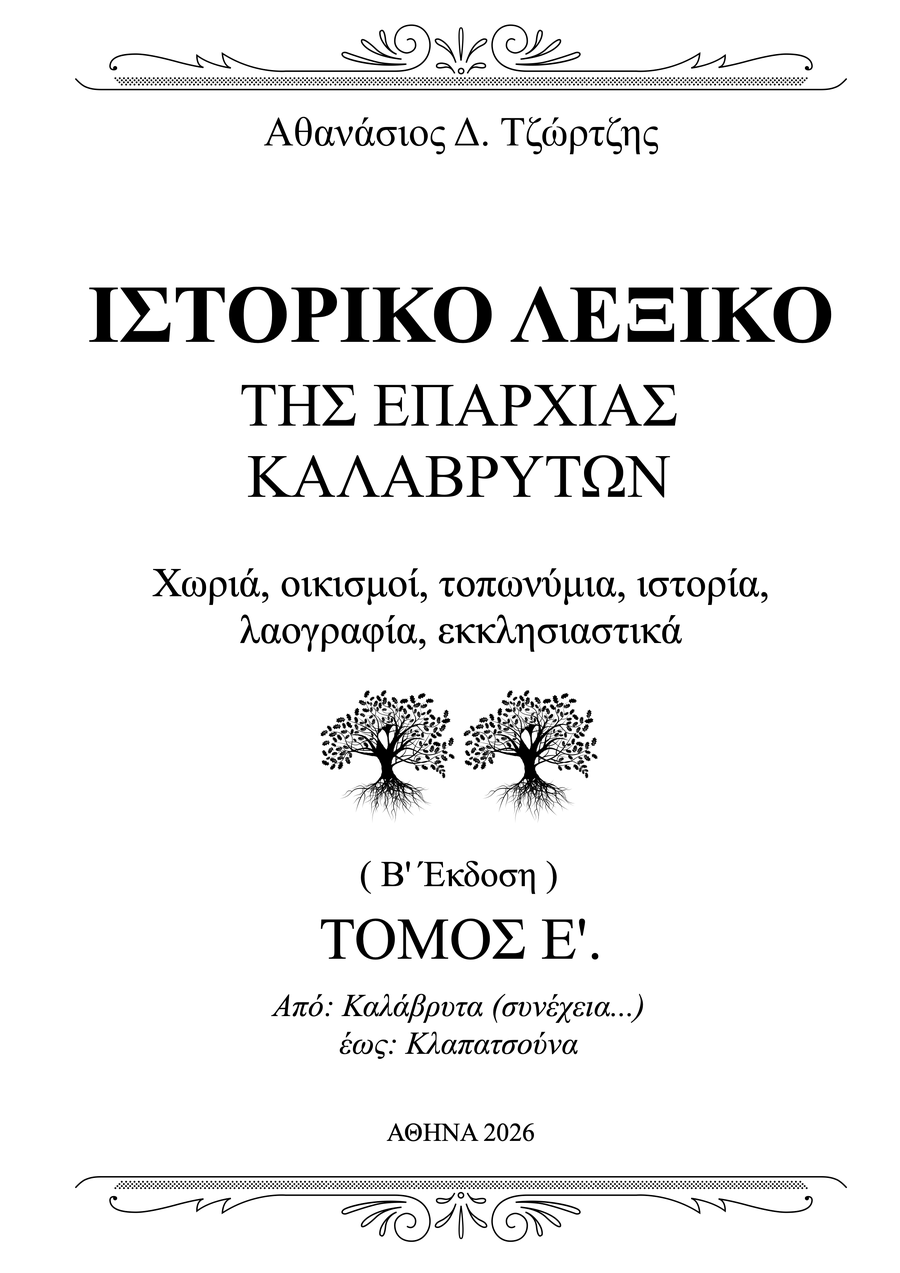
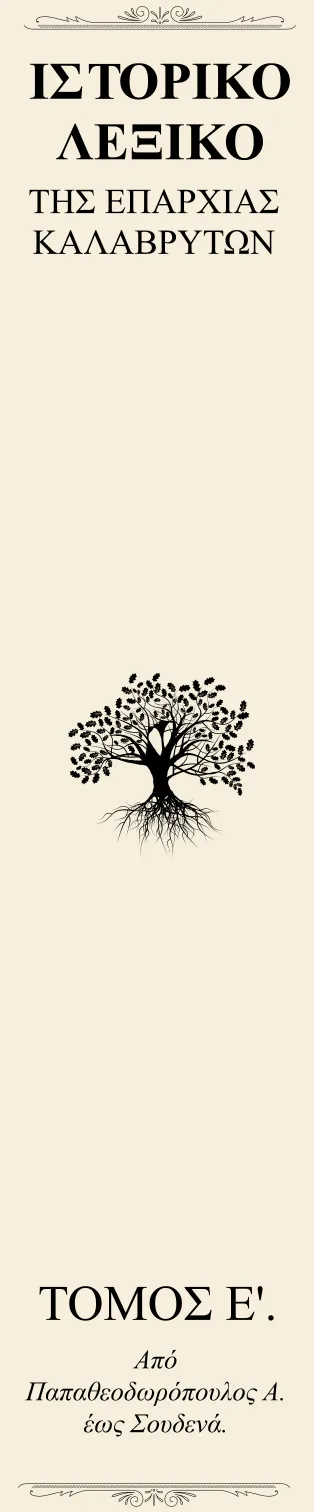
Volume Ε΄ from Καλάβρυτα (συνέχεια…)
to Κλαπατσούνα -
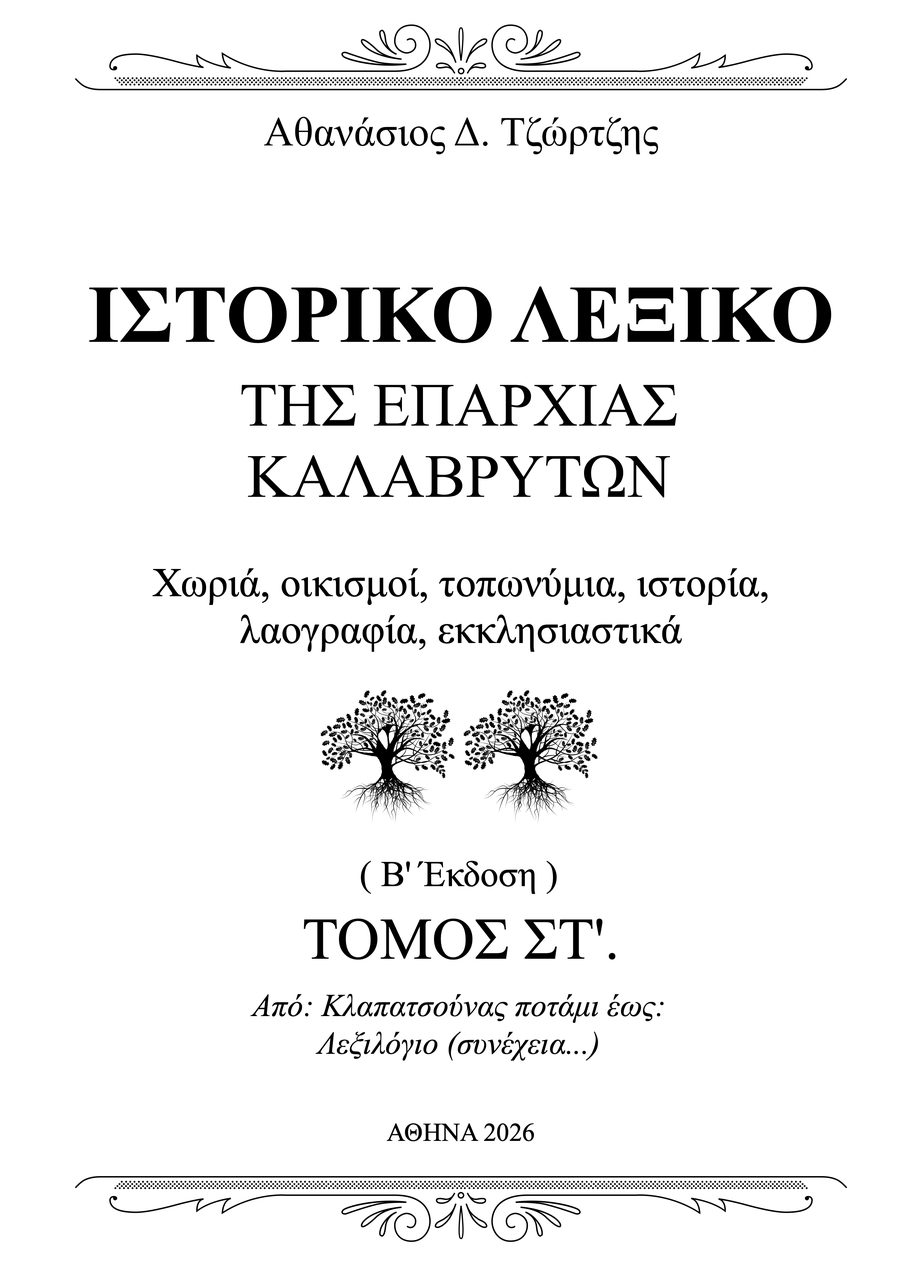
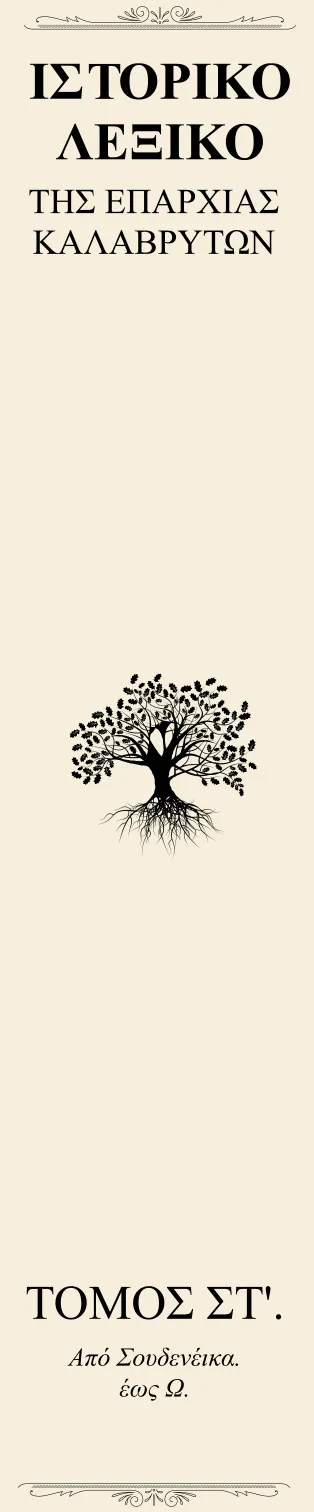
Volume ΣΤ΄ from Κλαπατσούνας ποτάμι
to Λεξιλόγιο (συνέχεια…) -
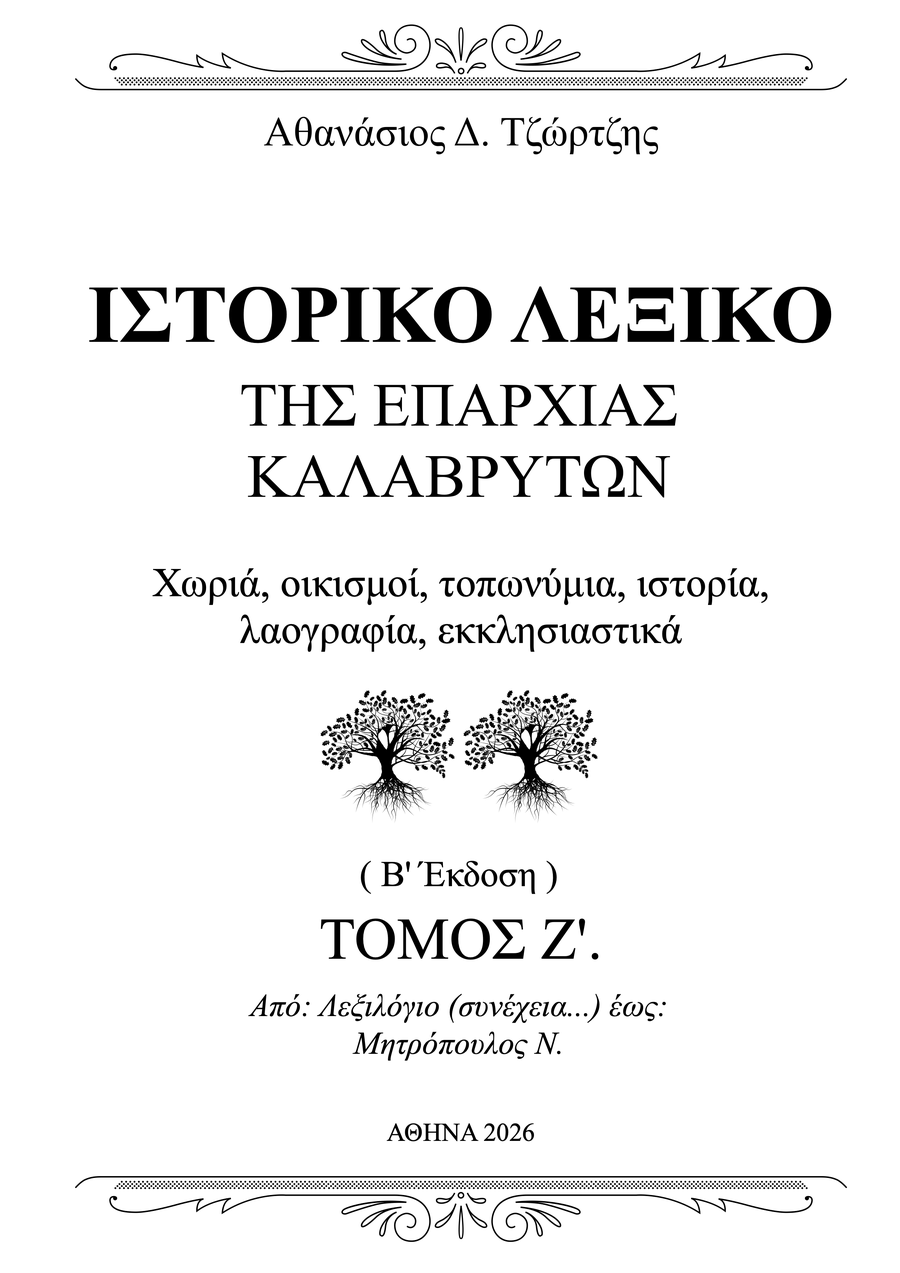
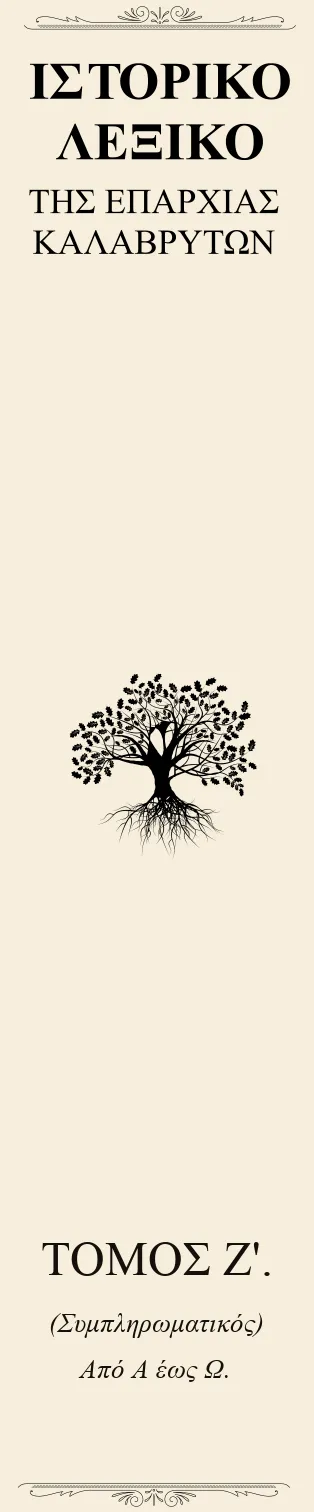
Volume Ζ΄ from Λεξιλόγιο (συνέχεια…)
to Μητρόπουλος Ν. -
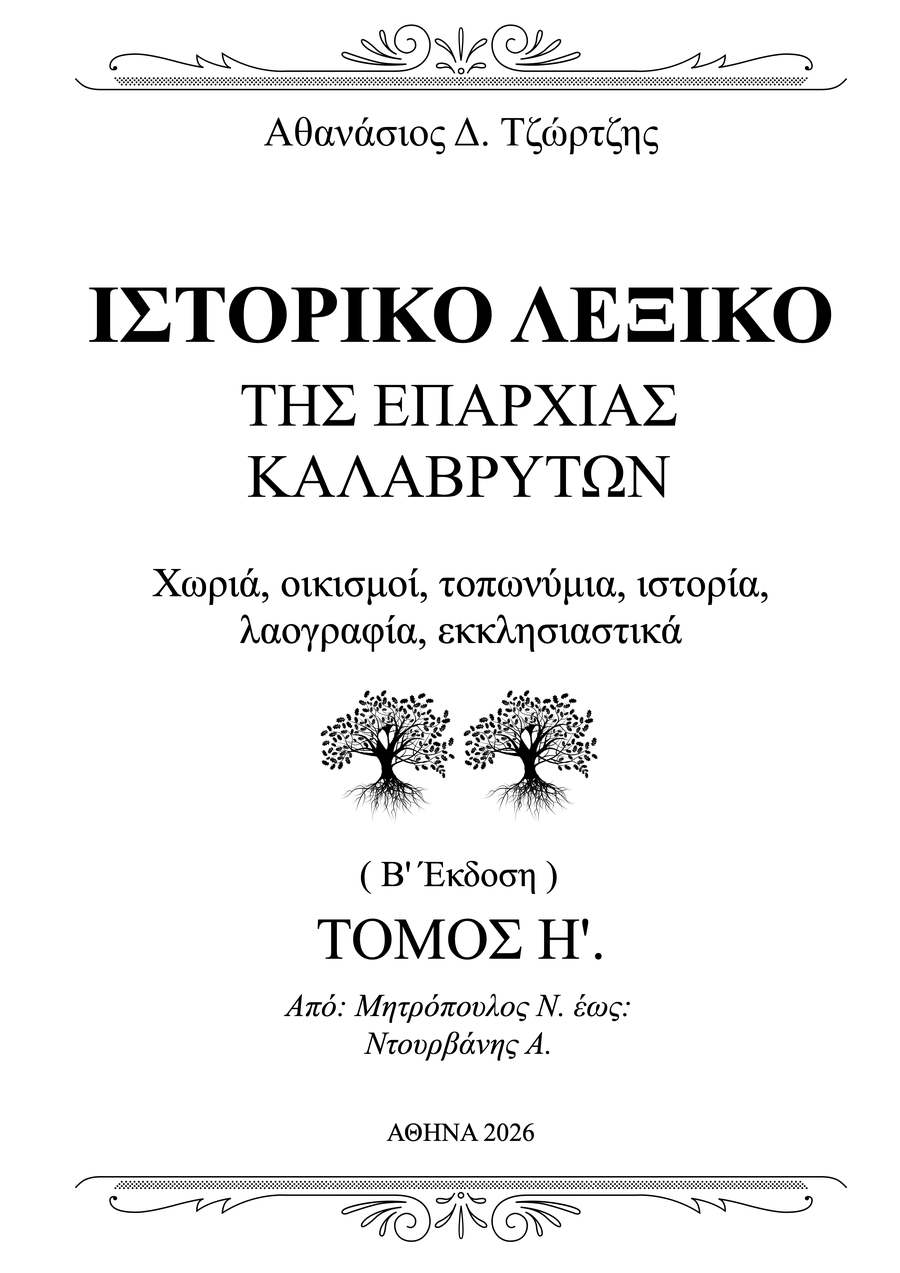
Volume Η΄ from Μητρόπουλος Ν.
to Ντουρβάνης Α. -
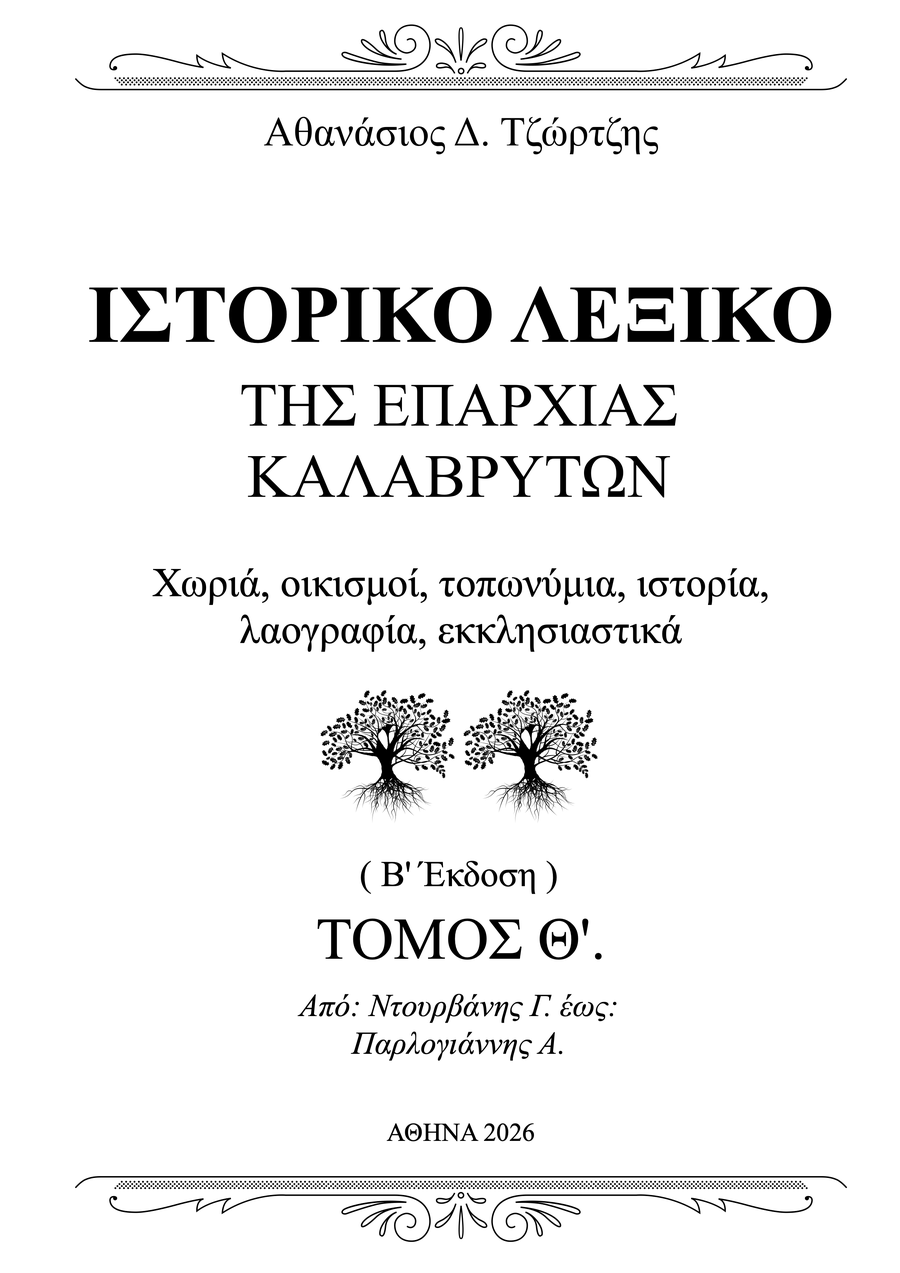
Volume Θ΄ from Ντουρβάνης Γ.
to Παρλογιάννης Α. -
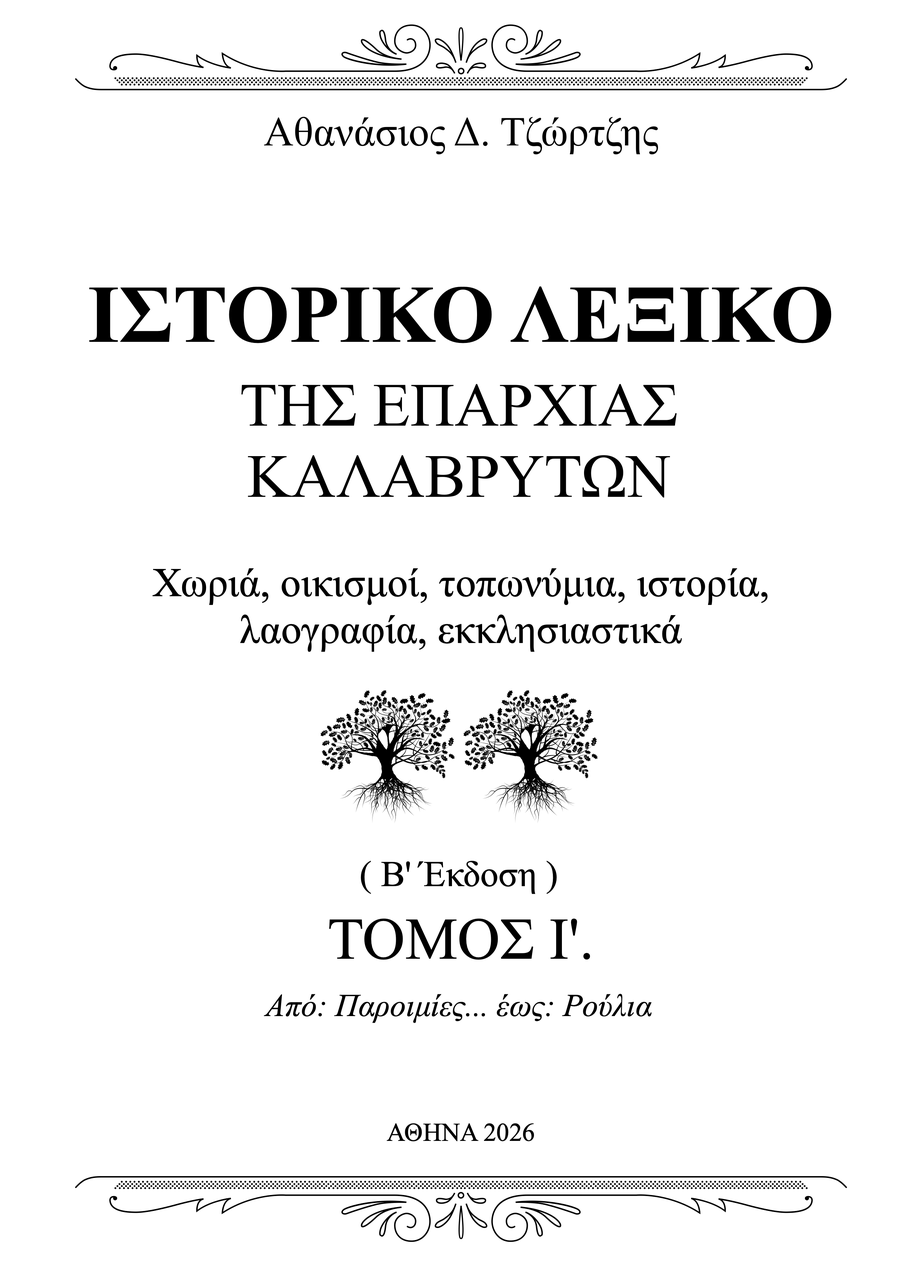
Volume Ι΄ from Παροιμίες…
to Ρούλια -
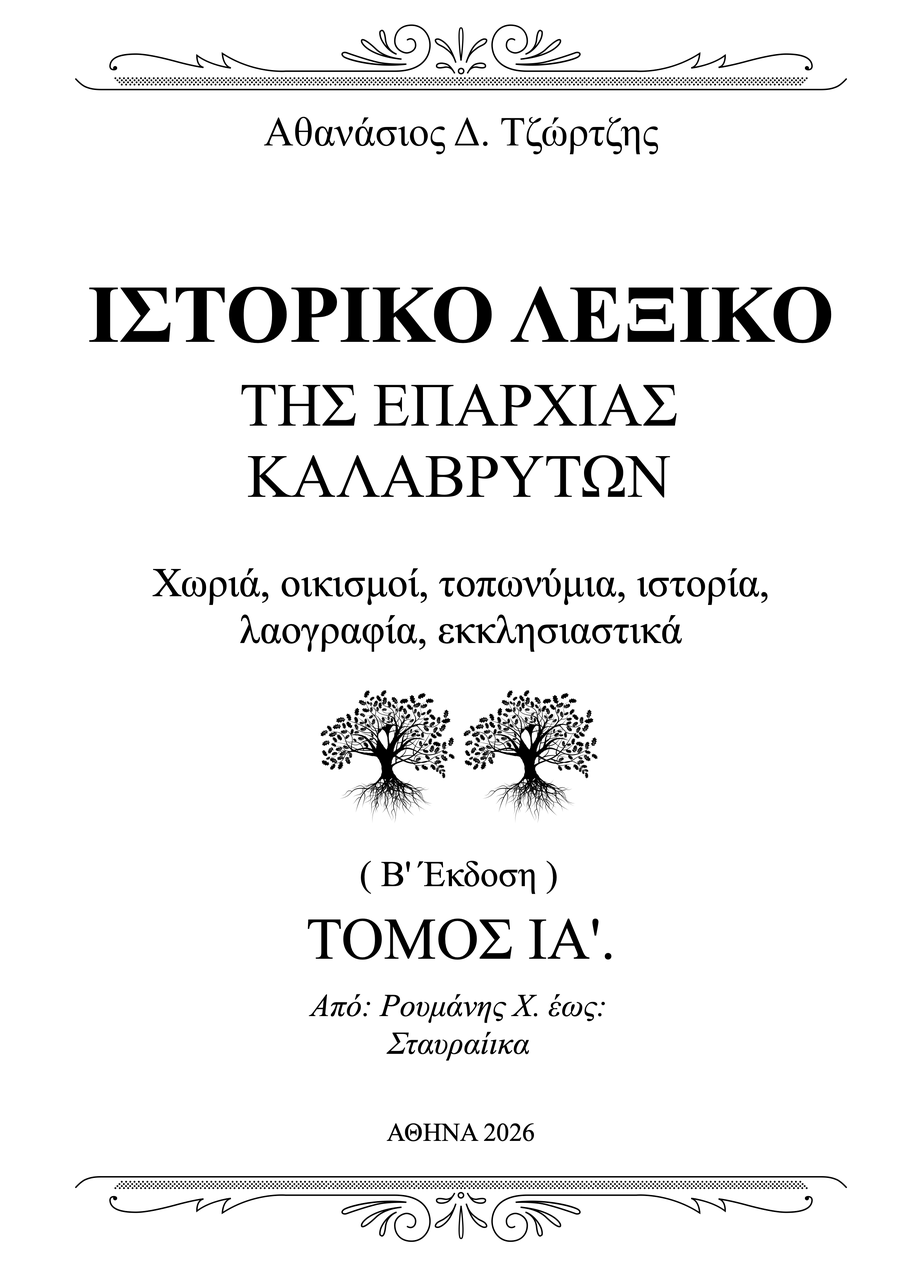
Volume ΙΑ΄ from Ρουμάνης Χ.
to Σταυραίικα -
Volume ΙΒ΄ from Σταυραϊτός
to Τομαρόπουλος Α. -
Volume ΙΓ΄ from Τομαρόπουλος Μ.
to Ω
Entries that are books in themselves
Some entries are monographs in their own right. The entry on the Monastery of Mega Spilaio runs to 228 pages, “Schools” to 225 and Agia Lavra to 138.
And these are only the dedicated entries — the same people, places and events are also referred to elsewhere in the work.
Index Sample entries
- Mega Spilaio Monastery 228 pp.
- Schools 225 pp.
- Taxiarches Monastery, Aigio 144 pp.
- Agia Lavra Monastery 138 pp.
- Pepelenitsa 57 pp.
- Agioi Theodoroi 40 pp.
- Outbreak of the Revolution 28 pp.
- Peristera 26 pp.
- Makellaria 25 pp.
- Mikros Bontias 21 pp.
- Perithori 20 pp.
- Tsarouchli 16 pp.
- Agia Moni 15 pp.
- Stamatis Bontiotis 13 pp.
Contents
-
Villages, settlements & place names
Some 150 villages and settlements of the province of Kalavryta and the place names of the area, together with its municipalities and their constituent communities.
-
Folklore
Traditions, myths, magic, haunted places, superstitions, folk medicine and beliefs, as recorded by students of the School of Philosophy in Athens. An extensive glossary of rare words and a collection of proverbs.
-
Population & elections
Population figures for each village from successive censuses and other sources, along with election results.
-
History of the villages
The origin, founding and development of each village, and the battles fought in or near it.
-
The fighters of 1821
More than 1,500 fighters of the Greek War of Independence who received or applied for honours, with their petitions and the certificates of service issued by leading chieftains, as well as soldiers who fell in later wars.
-
The Holocaust of 1943
Those executed by German forces in Kalavryta and the surrounding villages in December 1943, with details cross-checked against written sources.
-
People & electoral rolls
Notable people of the province and emigrants to America. Electoral rolls of 1865–1877 listing name, patronymic, occupation and age.
-
Churches, monasteries & schools
A record of the churches, monasteries and schools of the province, with their founding dates and special attention to the most notable.
From 7 to 13 volumes
The 1st edition appeared in 6 volumes in 2014 and was completed by a 7th in 2016. The 2026 2nd edition merges and expands them into 13.
1st edition2014–2016 · 7 volumes
2nd edition2026 · 13 volumes
-
2014
1st edition, 6 volumes. The result of 13–14 years of work, with more than 800 pages per volume.
-
2016
Supplementary 7th volume, 850 pages of material that came to the author’s attention after the first six were published.
-
2025
Harvard. The 7-volume edition enters Widener Library at Harvard University.
-
2026
2nd edition, 13 volumes. The supplementary volume is merged into the alphabetical sequence and the work is further enriched. It enters the catalogue of the Gennadius Library.
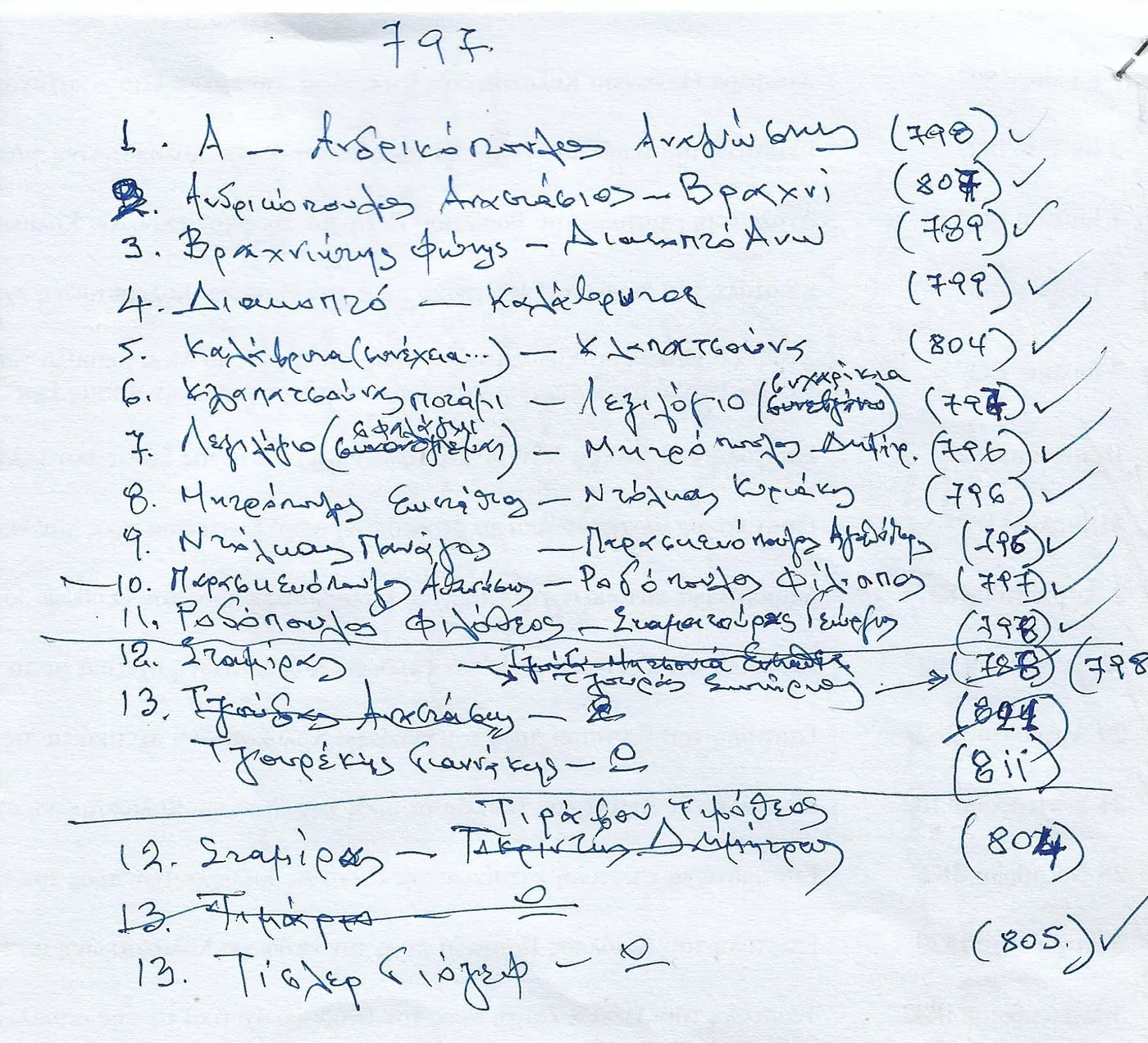
What the supplementary volume added
- Certificates of 1821 fighters that had been missing and were found at the Historical and Ethnological Society of Greece.
- References from the codex (“Defteri”) of the Monastery of Agioi Theodoroi, Aroania, and from the “Mertzios Codex”.
- Documents from the General State Archives on dowries for fighters, Ottoman estates, landowners, the “Neofotistoi” and monasteries.
- Handwritten rolls of 42 villages listing their farmers in 1856: surname, name, marital status, household members and age.
- Etymologies for almost every village, from Prof. Ch. P. Symeonidis’ “Etymological Dictionary of Modern Greek Settlement Names”.
- Material on the National Resistance of 1941–1944 in Achaea and some 1,450 names of fighters of the 12th Regiment of ELAS, from the ELIA archive.
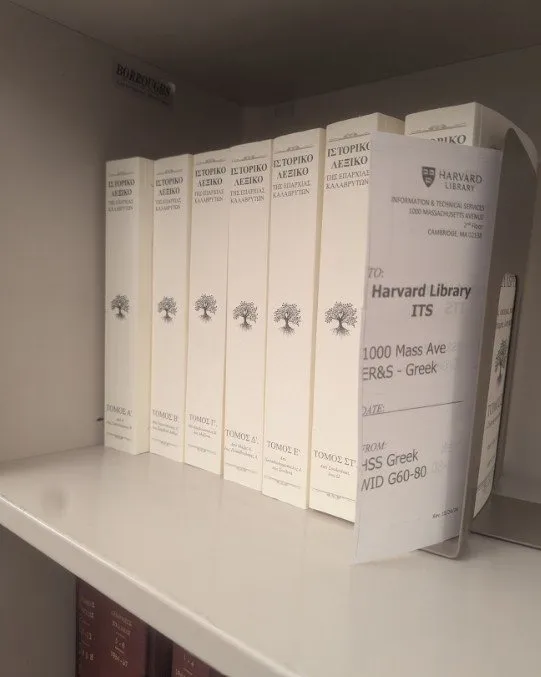
On the shelves of great libraries
The Lexicon has been selected by specialists and by leading institutions in Greece and abroad.
-
Widener Library, Harvard University Cambridge, Massachusetts
The 7-volume first edition joined the Greek studies collection.
-
Gennadius Library Athens
The 13-volume Lexicon and other books by the author are in its catalogue, open to all researchers.
-
School of Philosophy, University of Athens Athens
Selected the work for its collection.
-
National Hellenic Research Foundation Athens
Selected the work for its collection.
Frequently asked questions
How many volumes does the Historical Lexicon of the Province of Kalavryta have?
The 2nd edition (2026) has 13 volumes of more than 800 densely set pages each, measuring 17×24×4 cm. The 1st edition had 6 volumes (2014) plus a supplementary 7th volume (2016).
What does the Lexicon contain?
In alphabetical order: some 150 villages and settlements of the province of Kalavryta and their place names, historical and folklore material, population and election data, more than 1,500 fighters of the 1821 Revolution, the victims of the December 1943 Holocaust of Kalavryta, churches, monasteries and schools, electoral rolls and notable people of the area.
What sources is it based on?
On primary sources, chiefly the General State Archives of Greece, the register of the Fighters of 1821, military rolls, the Historical and Ethnological Society of Greece, the ELIA archive and many publications. The full reference of the source is given for every piece of information.
Where can I find or consult the Lexicon?
The 13-volume Lexicon is held by the Gennadius Library in Athens. The 7-volume first edition is held by Widener Library at Harvard University.
Is it sold in bookshops?
No. It was printed in very few sets at the author’s own expense. Anyone interested in obtaining a set can contact the author at tzathan@gmail.com with their full details and phone number.
Who is the author?
Athanasios D. Tzortzis, born in 1951 in Gerbesi (today Profitis Ilias), Kalavryta, a graduate of the Athens University of Economics (ASOEE). He has researched the history of the province of Kalavryta for more than 20 years.
“Since no work is perfect, for every error, omission or weakness of the present one the responsibility is mine alone, as I wrote, arranged and typeset it by myself; and so I commit myself to the fair judgement of the reader.”
— Athanasios D. Tzortzis, from the preface to Volume I